What is StumpVerse?
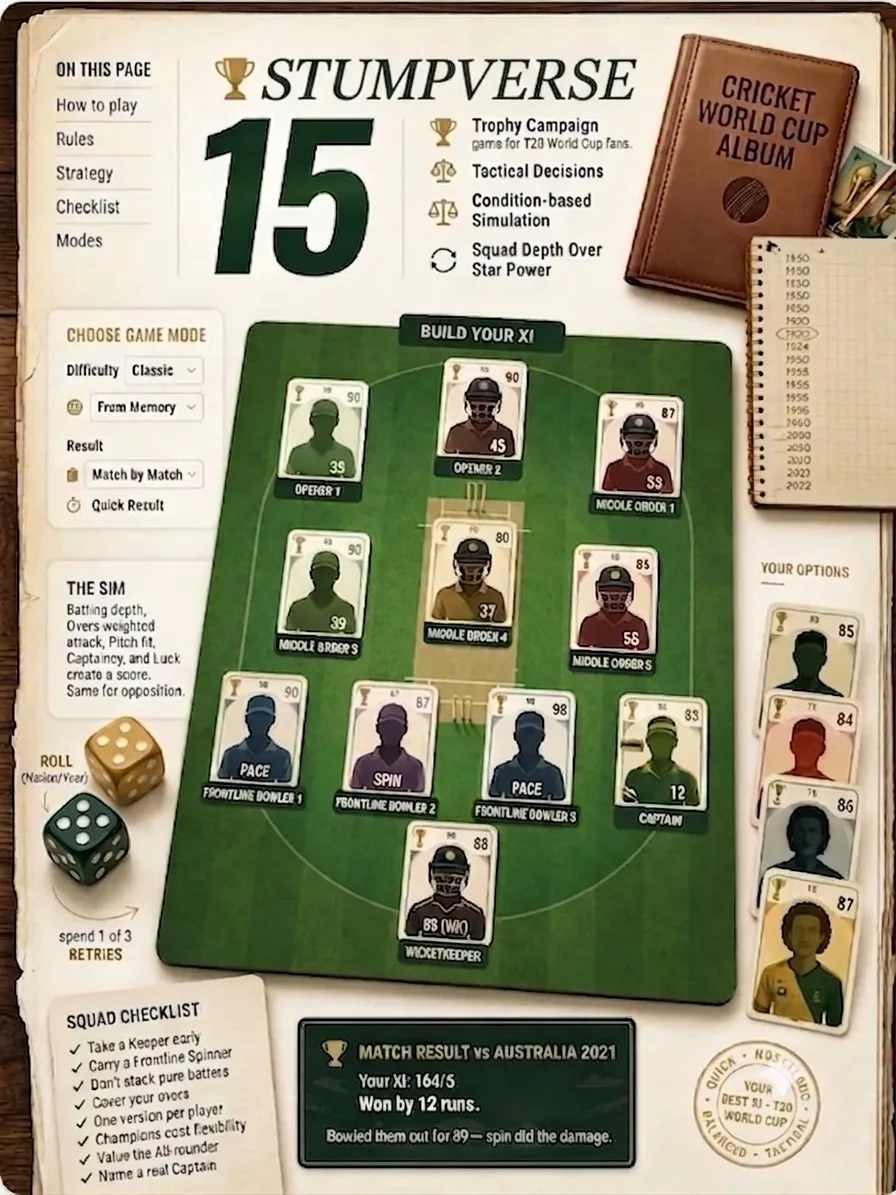
StumpVerse is a free T20 World Cup draft challenge for fans who remember teams as more than a list of names. Each turn draws one nation and one tournament year, say West Indies 2016 or Afghanistan 2024, and that real squad becomes your market. You draft one player who fits an open role in your fifteen, and the game keeps asking the same sharp question: do you take the biggest name, or the player your squad actually needs?
Whether you want to relive great eras, test your cricket memory, or build a side that can survive a brutal tournament run, StumpVerse is made for the way fans really think. The pool covers all ten men's T20 World Cups from 2007 to 2026: 25 nations, 152 real squads, and over 2,200 players, with every team from every edition. The fun comes from drawing iconic squads across that history, from the 2007 pioneers to champions like West Indies 2016, England 2022 and India 2024, and facing the pressure of choosing between a nostalgic favourite and the wrist-spinner your XI is crying out for.
A good run feels quick, but it is never empty. You roll, read the squad, weigh the open roles, and decide whether you need a keeper, a frontline seamer, a spinner, a finisher, or a captain who steadies the middle. Once the fifteen is set you name a leader, pick your XI for each day's conditions, and the simulation turns your draft into a story: a clean sweep, a last-over escape, a collapse, or the dream of lifting the cup. And above the trophy itself sits the run every drafter chases: 9-0. Four group wins, three more in the Super 8, the semi-final, the final. Nine matches, nine wins, the best result a T20 World Cup can hold.
How to play StumpVerse
Three phases, one decision at a time. The whole game is reacting to what you're dealt.
Draft your 15
Roll to draw a nation and a World Cup edition, say West Indies 2016. Pick one player into your squad. Not the draw you wanted? Spend one of three retries to redraw the nation or the year. Repeat fifteen times.
Name your captain
Choose a leader from your fifteen. The captain plays every match and steadies the side in close games, so picking a specialist who won't always make the XI is a genuine risk.
Play the tournament
Before each match you see the opposition, the pitch, the weather, and whether it's a day or night game. Pick your XI, choose a style of play, and simulate. Win your group, survive the knockouts, lift the trophy.
Rules and scoring
Deliberately few rules. The tension comes from conditions, not from a rulebook.
Fifteen, your way
Any mix of batters, bowlers and all-rounders. The only hard requirement is at least one wicketkeeper. Balance is a bet on conditions you haven't seen yet.
Two selection rules
Your XI needs at least one keeper and enough bowlers to cover 20 overs, and it must include your captain. Everything else is your call.
The pitch decides plenty
Every match draws a surface: green seamer, dry turner, flat deck or balanced. The attack that suits the pitch has the edge before a ball is bowled.
Weather sits on top of the pitch
Each match also draws a sky: clear is neutral, overcast helps the seamers swing it, and hot, dry air grips for the spinners. An overcast green top is a pace bowler's dream; a hot day on a turner doubles down on spin.
Night games bring dew
Day matches play true. In a day/night game, dew arrives with the chase: the ball skids onto the bat and spinners lose their grip, so the side batting second gets a real edge. Win the toss-up of conditions, not just names.
One transparent formula
Batting depth, an overs-weighted attack, how well your XI fits the pitch and weather, captaincy and a little luck combine into a score. The same formula runs for the opposition.
Strategy: build the attack before chasing the headline name
A squad of famous names loses to a balanced one. You draft blind to the pitches you'll face (green seamer, dry turner, flat deck, balanced), so the question is never just "is this player good," it's "does my fifteen still work if the final is played on a raging turner."
Scarcity matters too. Once a player is drafted into someone else's squad in Play with friends, they're gone from the pool for good. The same real cricketer can never appear in two lineups. Even in solo play against the historical dataset, the lesson holds: the fifth batter who can also bowl ten tidy overs is usually worth more than the sixth big name.
Bet on conditions
Stack pace and no spin, and a semi-final turner will punish you. Carry both, always.
Read the sky, then the surface
Overcast lifts your seamers even on a flat deck; hot, dry air turns a balanced pitch into a spinner's day. Pick the XI for the pitch and the weather together, not just the strip.
Chase under lights
Night matches bring dew in the second innings, so the chasing side bats easier and spinners struggle to grip late. If the toss of conditions goes your way, lean toward the chase.
Cover your overs
Twenty overs, four per bowler. Three frontline bowlers leave eight overs for someone, so make sure that someone isn't a part-timer at ten an over.
Captaincy is real
A strong captain reduces collapses in tight games. Give the armband to a genuine leader who'll play every match.
Steer the reroll
Short a spinner? Hold the nation and reroll the year to stay in a spin-rich pool. The retry is a decision, not a coin flip.
Read the margin, not just the result
A 2-wicket win with your top order exposed is a warning, not a pass. The scorecard tells you what actually needs fixing before the next match.
All-rounders solve two problems at once
A genuine all-rounder covers overs and bats deep without spending a full slot on either job. It's the cheapest kind of squad depth you can draft.
Style is a lever, not a lock
Attacking, normal, or defensive changes how an innings plays out. Chasing a small target calls for a different plan than defending a big one.
Even a tie has a script
A dead-level match goes to a Super Over, and the side that batted second in the main match bats first in it. Know the rule before you're relying on it.
A quick checklist before you roll
Twelve habits that separate a squad that wins tournaments from a highlight reel that loses in the group stage.
Why a tournament-specific draft hits different
Most cricket fantasy games rate a player on their whole career: a flattened, one-number version of someone who was electric in 2016 and a shadow of themselves by 2022. StumpVerse doesn't do that. Every rating is tied to one specific squad at one specific World Cup, based on research into that tournament's real matches. Draft West Indies 2016 and you get the side that actually turned up that year, not a career-average approximation of it.
That's also why the draft rewards memory over recognition. A famous name from a poor tournament rates lower than a role player having the tournament of his life, which means the fan who remembers how West Indies actually won in 2016, not just that they did, has a real edge. It's the same instinct that makes arguing about squads fun in the first place: not "who's the best," but "who actually delivered, and when."
Pick the mode that suits you
Two independent choices, and they mix freely: how much the game tells you while you draft, and how much control you keep once the tournament starts.
New to StumpVerse? Classic plus Match by match is the way in: you see everything and decide every game. Once you know the shape of the draft, From memory turns the same fifteen picks into a real cricket-knowledge test, and Quick result turns a whole campaign into a five-minute story you can rerun with a different fifteen.
Classic
Ratings are shown, the best legal picks are highlighted, and a live Captain's Report flags a thin attack before you play. The way in.
From memory
Ratings and recommendations are hidden. You draft and select on cricket knowledge alone. The purist's game.
Match by match
Pick a fresh XI before every match, seeing that match's opposition, pitch, weather, and day/night slot first. The full, deeper game.
Quick result
Pick your XI once, and every match after plays out on its own, showing the pitch, XI, and scorecard for each one, so you can watch the story unfold instead of clicking through it.
What makes a StumpVerse draft satisfying?
A good draft is a sequence of small, real trade-offs, not one big decision. Fifteen picks in, you're not thinking about "the best team" any more. You're thinking about whether the keeper you rolled third pick still has any right to be there, now that a better one just showed up on pick eleven.
The tension holds because you're drafting blind to the conditions you'll actually play in. A squad that looks complete on paper can still be short a spinner when a dry turner shows up in the semi-final, and by then the draft is over. That's the whole game: build for conditions you haven't seen yet, then find out, over a full tournament, whether you read the risk right.
Common questions
What is StumpVerse?
A free browser game: draft a 15-man T20 World Cup squad one player at a time, name a captain, then pick your XI match by match against real historical sides.
Which tournaments are included?
Every men's T20 World Cup from 2007 to 2026: 10 editions, 25 nations, 152 real squads and over 2,200 players, with every team from every edition. Ratings are tournament-specific, built from research across every tournament.
Do I need an account?
No. There is no login, no download, and no payment. Open the page and play. Every run has a seed you can share.
How are ratings worked out?
Ratings are tournament-specific, not career averages. Each one reflects how a player actually did at that World Cup, based on researched match data from every tournament: runs and strike rate for batting, wickets and economy for bowling.
What is the perfect result?
A 9-0 campaign: win all four group games, all three Super 8 games, the semi-final, and the final. Nine wins, zero defeats, the best run a T20 World Cup allows. Very few drafts survive it.
Can I share my result?
Yes. A finished campaign produces a record and a seed, so a friend can replay the exact same rolls and compare squads.
What do weather and day/night matches change?
Weather is drawn per match alongside the pitch: overcast skies help seam bowling, hot and dry air helps spin, clear is neutral. Night matches add dew in the second innings, which makes chasing easier and blunts spinners late on.
What happens if a match ties?
It goes to a Super Over, same as real cricket. The side that batted second in the main match bats first in the eliminator.
Can I play against a friend instead of the computer?
Yes. Play with friends is a live, turn-based version with the same roll-and-pick draft as solo play, except a player your friend drafts is locked for you. Then you play a head-to-head series.
Is this affiliated with any board or the ICC?
No. StumpVerse is an independent fan project and is not endorsed by any cricket body, player, or broadcaster.